
World Natiometric Observatory (WNO)
Led by the International Natiometry Society (INS)
Central Infrastructure : SPACESORTIUM
Preamble
Faced with the increasing complexity of contemporary societies and the acceleration of informational flows, understanding national and civilizational dynamics requires a comprehensive global scientific framework.
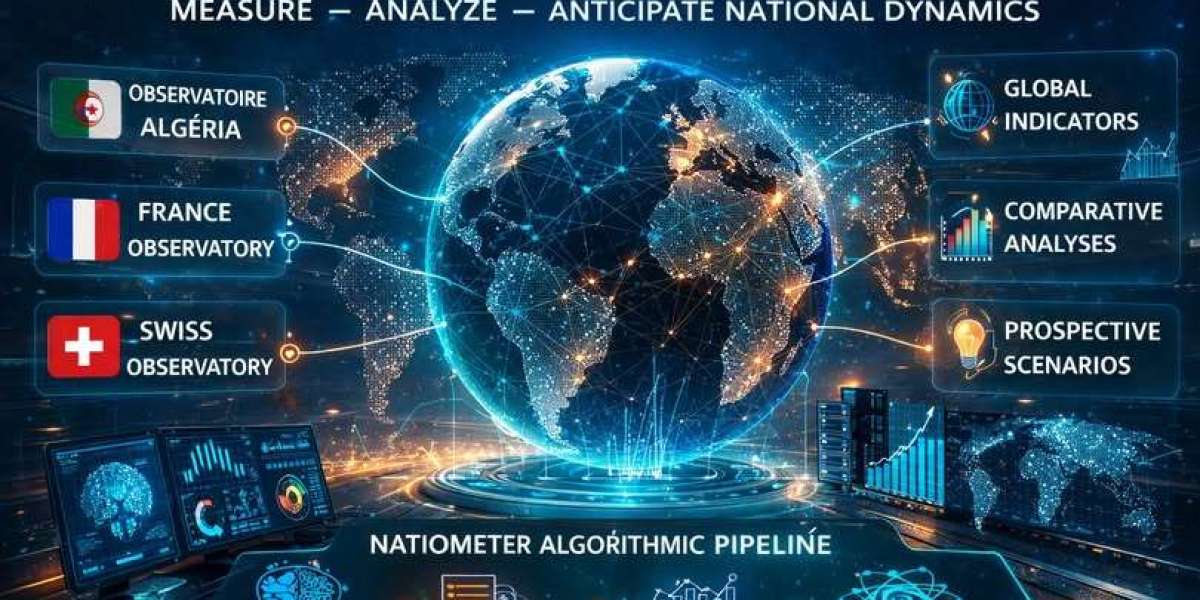
The World Natiometric Observatory (WNO) is designed as the international reference center for the systemic and algorithmic analysis of nations, capable of measuring, modeling, and comparing collective dynamics at a planetary scale.
It is part of the International Program of Natiometric Observatories, which groups national observatories currently in deployment (Algeria, France, Switzerland), providing a framework for the gradual integration of additional nations.
I — Vision and Mission
Vision:
To become the international scientific infrastructure of reference for the measurement and modeling of national and civilizational systems.
Mission:
-
Centralize and structure national and transnational data.
-
Provide longitudinal and comparative analyses of national systems.
-
Detect weak signals and anticipate sociopolitical and cultural transformations.
-
Develop global and multi-scale natiometric indicators.
-
Promote scientific collaboration and knowledge sharing between nations and institutions.
II — Founding Principles
-
Scientific neutrality: analyses are independent and based on rigorous methods.
-
Plurality of sources: integration of media, historical archives, social networks, and institutional data.
-
Methodological transparency: full traceability of all processes and algorithms used.
-
International comparability: common standards to ensure coherence across nations.
-
Continuous innovation: adoption of the latest advances in AI, NLP, dynamic modeling, and data science.
III — Organizational Architecture
The WNO is structured around three complementary levels:
-
National Level: Pilot Observatories
-
Algeria, France, Switzerland (initial phase).
-
Teams: local scientific teams specialized in natiometry, social sciences, and data science.
-
Missions: collect and process national data, calibrate the Natiometer, produce national indicators.
-
-
Regional / Continental Level: Integration Hub
-
Objective: consolidate national analyses and perform regional comparisons.
-
Functions: harmonize methodologies, coordinate calibration cycles, create interconnected databases.
-
-
Global Level: Central Observatory
-
Role: supervise the entire network, coordinate global research, and produce global reports on national and civilizational dynamics.
-
Components:
-
Algorithmic Center: manages the global Natiometer pipeline (NLP, thematic extraction, temporal analysis, dynamic modeling).
-
Visualization & Indicators Center: interactive dashboards, mapping, international natiometric indices.
-
Foresight Laboratory: simulations, prospective scenarios, analysis of civilizational cycles and weak signals.
-
-
IV — Technical Architecture
At the heart of the WNO lies the Natiometer algorithmic pipeline, implemented at a global scale:
-
Data Processing: automated collection of texts, archives, and international media streams.
-
Thematic Extraction: categorization of content according to political, cultural, economic, technological, and symbolic axes.
-
Temporal Analysis: longitudinal monitoring of narrative dynamics and societal cycles.
-
Dynamic Modeling: simulation of national and civilizational trajectories, integration of long-term cycles and natiometric phase spaces.
Each nation benefits from local calibration, ensuring contextual relevance of analyses, while the central pipeline guarantees global comparability.
V — Information Flows and Partners
-
Primary Sources: national and international media, historical archives, public institutions, social networks, scientific databases.
-
Scientific Partners: universities, research centers, data science laboratories.
-
Institutional Partners: international organizations, governments, NGOs, and cultural institutions.
VI — Indicators and Outputs
The WNO produces analytical outputs at multiple scales:
-
National Indicators: narrative cycles, social cohesion, debate polarity, collective representations.
-
Comparative Indicators: relative evolution indices, transnational weak signals, convergence/divergence analyses.
-
Prospective Reports: transformation scenarios, trajectory simulations, identification of areas of fragility or resilience.
-
Visualization Tools: interactive maps, flow charts, dynamic timelines, natiometric dashboards.
VII — Governance and Management
-
International Scientific Committee: validation of methods, supervision of analyses, strategic recommendations.
-
Operational Management: coordination of national observatories and regional hubs.
-
Ethics and Neutrality Unit: bias control, respect for plurality of sources, data security.
VIII — Expansion Perspectives
-
Gradual integration of all nations into the network.
-
Development of specific modules for the analysis of crises, conflicts, and economic transformations.
-
Deployment of multi-nation and multi-cultural simulation tools.
-
Publication of scientifically validated annual global reports on the dynamics of nations.
IX — Conclusion
The World Natiometric Observatory represents the convergence point for natiometry on the international stage.
By bringing together collective memory, data science, and artificial intelligence, it opens the way to a global, rigorous, and prospective understanding of national and civilizational systems.
Motto:
"Observe the world to understand each nation, measure each nation to illuminate the collective destiny."
#WNO #Natiometry